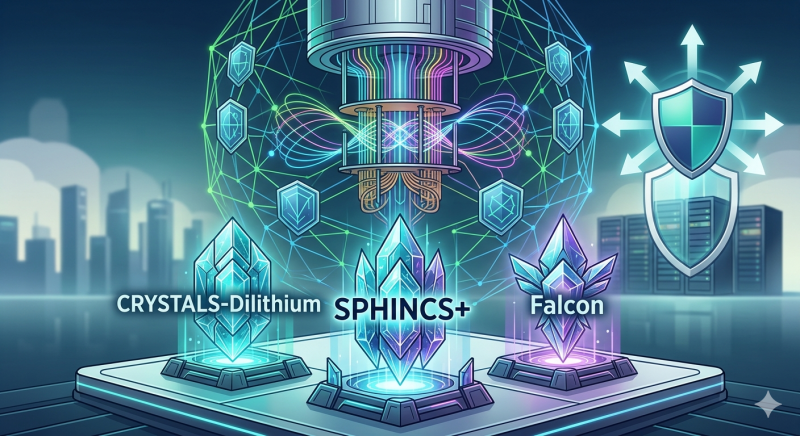
Post-Quantum Cryptography: Navigating the Three Pillars of NIST Standardization
An informative overview of the Post-Quantum Cryptography (PQC) landscape, focusing on the three critical pillars of the ongoing standardization effort led by NIST.
The Quantum Threat and the Need for PQC
The advent of large-scale, fault-tolerant quantum computers poses an existential threat to most public-key cryptography systems. Classic asymmetric algorithms like RSA and ECC rely on mathematical problems (factorization, discrete logarithm) that Shor’s algorithm can efficiently break. In response, the global community has developed Post-Quantum Cryptography (PQC): new algorithms designed to be resistant to quantum attacks.
To anticipate this disruption, NIST (National Institute of Standards and Technology) launched a rigorous standardization process in 2016. As of 2024, several standards have been finalized to ensure the security and interoperability of future digital communications.
The Three Pillars of PQC Research
The NIST project is structured around distinct mathematical families to ensure maximum resilience:
1. Lattice-Based Cryptography
This is the core pillar, relying on the hardness of problems like the "Shortest Vector Problem." These algorithms are favored for their efficiency and strong theoretical security guarantees.
2. Code-Based Cryptography
Utilizing error-correcting codes, this approach offers a robust alternative with a mathematical structure fundamentally different from lattices.
3. Hash-Based Cryptography
This leverages the properties of cryptographic hash functions. Highly secure for digital signatures, it provides high assurance of integrity despite typically larger signature sizes.
Focus on Finalized Signature Standards
CRYSTALS-Dilithium: The Default Standard
The primary recommendation by NIST, based on the Module-LWE problem. It offers an excellent balance between size and performance, making it ideal for TLS and PKI.
Falcon: Compactness and High Technicality
Based on the NTRU structure and Fast Fourier Transform (FFT), it produces extremely compact signatures, perfect for IoT and blockchain, despite its complex implementation.
SPHINCS+: The Conservative Approach
Completely independent of lattices, this hash-based algorithm serves as a strategic safety net. Should lattices be theoretically compromised, SPHINCS+ would remain secure.
Synthetic Technical Comparison
Algorithm Family Signature Size Complexity Use Case Dilithium Lattices (LWE) Medium Low Universal Standard Falcon Lattices (NTRU) Very Small High IoT, Blockchain SPHINCS+ Hash-based Very Large Medium Critical SecurityImplications for the Future
NIST adopts a multi-algorithm strategy to avoid a single point of failure. The transition will not be monolithic but hybrid. Organizations must now begin migrating legacy systems to ensure the longevity of the digital world in the quantum era.
Sources: NIST PQC Project